latest News

How NOT to Start Barefoot Running
I was on a panel discussion about barefoot running a while back. At one point, someone in the audience asked,So how do I transition to barefoot running?NOTE -- even if you're not a runner, this story is still relevant and important for you... okay, back to the story...Before I could respond, a well-respected physical therapist suggested the following:“First, switch to a slightly lower-heeled shoe than what you have. Run in that for a few months. Then switch to a racing flat, maybe one day a week for a while… then add an extra day every month, until you can run in those. Then maybe try something like Vibrams on a soft surface, like grass in a park. Work up to being able to run on the grass… then try a soft dirt path. Eventually you may be able to run on hard surfaces, but don’t do that too often. And I don’t recommend being totally barefoot because you could step on something.”The only reason I didn’t interrupt him was that I was in shock!I had never heard anything so insane in my life. Until he he tossed out his next bit of barefoot running advice:“Expect to spend about 2 to 3 years making the transition. That’s how long I’ve been doing it and I’m still not there.”That's when my shock gave way to action, and I took off the politeness gloves.“Hold on,” I said, “this is completely upside down and wrong!”Danny Abshire from Newton jumped in as well, “Right, that’s backwards.”I’ll tell you what Danny and I proposed, instead, in just a moment. But first, let’s back up to the question that started it all.“How do you transition!?”The idea built into the question itself seems to make sense. If you’re wearing a motion-controlled shoe with a 3″ heel and a $400 orthotic, it seems logical that you need to slowly wean yourself from all that support. It seems clear that you would need to get comfortable in a lower and lower heel until you’re ready for barefoot.But as we've already seen in the previous days of this course, things are not always as they seem.Here’s the bottom line: There is nothing that “prepares” you for being barefoot. Nothing.Not “zero-drop” shoes (where your heel is at the same height as the ball of your foot). Not Vibrams. Not a thinner insole. Not even Xero Shoes (more about those in a second).Anything that you put on your feet will change either your stride and biomechanics, or the amount of sensation you’re feeling in your feet (or both) compared to being barefoot. So once you take off your shoes, or fully feel the ground, you’ll need to learn to move differently.Here’s where some people stop reading what I’m saying and respond with two arguments (to points I’m not making).First, they’ll say, “Oh, so you’re some sort of barefoot purist! Who are you to tell me what to wear or not wear?”To be clear, I’m not telling anyone what to wear and I’m not saying barefoot is the only way to be. Admittedly, the majority of my time I am in Xero Shoes, but not always (more about when I'm not, and when you shouldn't be in an upcoming lesson).This article is about the myth of “transitioning”, not about your footwear, or lack thereof.Secondly, people will say, “Yes, but switching to a racing flat or zero-drop shoe will give your Achilles time to stretch and strengthen, and that better prepares you for being barefoot.”To them I say, “Not always. And for almost everyone, your Achilles has more than enough stretch. And, even if it were true that you needed to stretch your Achilles, there’s a better way than spending 2-3 years to make that happen.”Keep in mind that the biggest reason for going totally barefoot is that feeling the ground with your skin gives you the most feedback about your form. Feedback that, if you attend to it, can inspire you to change your gait to something more efficient, easy, and natural. Running in Xero Shoes is, really, the same... if they covered everywhere you stepped in 4-6mm of flexible rubber.All the other shoes I've tested reduce the amount of ground sensation you feel so that you don't get the feedback you need to adjust your gait.I’ve seen hundreds of people in VFFs or racing flats who still heel strike or have some other gait pattern where they aren’t getting much if any extra “Achilles strengthening and stretching”.So, what’s the better way to “transition” that Danny and I chimed in with? Take off your shoes (or put on your Xero Shoes), find the hardest and smoothest surface you can find (like a bike path or street) and run. But only do it for about 200 yards. See how you feel the next day. You may be sore, you may be fine. If you’re sore, wait until you’re not. Then go try again, and add 100 or 200 yards. Repeat. I think of this as the “Shampoo method” of barefoot running. Instead of “Lather, Rinse, Repeat,” it’s run a little, rest, repeat (and run a little more).Keep in mind, there are two types of soreness. One is from using muscles you haven’t used in a while, or using them in a way you haven’t used in a while (if ever), or using them a bit more than usual.The other is from doing something wrong. Like doing way too much distance (which part of 200 yards was confusing to you?), or trying to stay on your toes without letting your heels ever touch the ground (Not necessary… land mid- or forefoot, but your heel can touch down. No need to do 200 yards of calf raises).In other words, a little soreness is probably normal. A lot of soreness is telling you to try something different.And this idea that you need to be on soft surfaces. Completely wrong. And wrong for the same reason that you don’t want to be in cushy running shoes.Give yourself a soft surface and the odds are good you’ll heel-strike. Plus, soft surfaces don’t give you the feedback you want, the kind that can help you quickly learn a new and better way to run. I’ve seen barefoot runners who’ve only run on grass, and they usually look like shod runners who lost their shoes.Instead of thinking that you can work your way to barefoot or huaraches slowly, go there immediately. But work your way up in time/distance slowly.All the strengthening that you want to do before you run barefoot, you’ll get that faster by running barefoot.All the stretching you need (if, in fact, you need any), you'll get that by building up your distance, slowly.To misquote Yoda’s famous “There is no try. Only do.” There is no transition, only run (or walk, as the case may be).Oh, and in the next lesson, I'll share some of the most important tips about exactly HOW to run barefoot, including some suggestions that, frankly, I never wanted to share with anyone... shhhhh.Let me know what you think. Put in your comments, below.The content of this post does not constitute and is not intended to be a substitute for professional medical advice, diagnosis or treatment. Always seek the advice of a physician or other qualified health provider with any questions or concerns you may have about your health or a medical condition.
How to find TRULY comfortable shoes
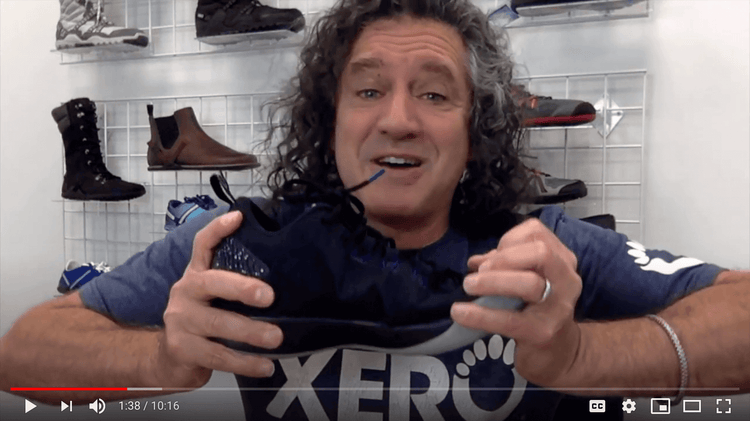
The secret to finding comfortable shoes... It's probably not what you think. And it's definitely not what "Big Shoe" companies have been saying for the last 50 years. It's not because you need more arch support or better cushioning or to control your pronation or supination. The secret is actually what humans have been doing for ages. The secret to TRUE comfort is letting your feet do what's NATURAL. Think about this -- did you know 1/4 of the bones and joints of your ENTIRE body are in your feet and ankles? Did you know you have more nerve endings in your soles than anywhere but your fingertips or lips? CLEARLY, you're supposed to USE those things at the end of your legs. Your feet are made to bend and flex and move and FEEL the world (you'll want to do that safely, and I'll show you how). And it gets worse >> When your feet can't do their job, that function of helping you move and balance tries - UNSUCCESSFULLY -- to move "upstream" into your ankle, your knee, your hip, and your back. You want to let your feet do their job, so the rest of your body can do its job. But most shoes do the opposite of what's natural -- they squeeze your toes together, they elevate your heel (which messes with your posture), they insulate you from the ground so your brain can't tell what's going on with your feet (which means it doesn't have the info it needs to help you move your body efficiently and enjoyably). And NO amount of cushioning protects you from the impact of walking or running, or even just standing. ANOTHER QUESTION -- Remember being a kid on a warm summer day and going outside, kicking off your shoes, and feeling the grass between your toes, or the sand under your feet, or the water around your ankles? Remember how much fun it was to PLAY... until it got so dark your parents had to drag you home, even though you couldn't see your hand in front of your face or the ball you were trying to kick or hit? You can have that feeling of fun and freedom NOW... at any age. It comes from letting your feet do what's natural. Now, I'm NOT suggesting you run around barefoot like some aging hippy (I know that's what I look like, but my wife said she'd leave me if I cut my hair!) Once my wife and I discovered the fun and the benefits of natural movement, we started Xero Shoes to make footwear that LETS YOUR FEET BE FEET: - Natural Fit -- wide toe boxes let your toes spread and relax. A non-elevated (zero-drop) heel for proper posture. - Natural Motion -- super flexible to let your feet bend and move naturally. Low-to-the-ground for balance and agility. - Natural Feel -- the patented FeelTrue® soles give you just-right protection while still giving the ground feedback your brain needs for efficient, natural movement. All our casual and performance shoes, boots and sandals are super lightweight. They're made for almost any activity you do -- walk, run, hike, workout, do yoga or CrossFit, or even just stand on your feet all day for work. They're so comfortable that at the end of the day you may forget to take them off! We've had people email us to say, "I got into bed and then realized I was still wearing my Xero Shoes!" Plus they're affordable and so durable that they have a 5,000 mile sole warranty. Oh, and yes, we WERE on Shark Tank ;-) We've helped hundreds of thousands of people discover the fun, comfort, and benefits of natural movement and we hope you decide to do the same. Go to https://xeroshoes.eu/shop/ to see which styles have your name on them. Check out the reviews (over 38,000 5-star reviews!), and get ready to Live Life Feet First! (And if you have any questions, our Customer Happiness Team is available to help -- +420 228 880 373 or support@xeroshoes.eu)

Will Barefoot Running Heal My Injuries?
As barefoot running and walking (and hiking, and kayaking, and anything else you can do barefoot) become more popular, the one question that comes up more and more is:Will being barefoot or in Xero Shoes cure me of my problems?And the list of problems includes: Flat feet High arches Leg length differences Plantar fasciitis and heel pan Achilles tendonitis Pain in the ankle, foot, knee, hip, back ... and a LOT more This is a good question.And if you hang out in the barefoot world, you will definitely hear from someone who says that being barefoot cured them of pretty much anything and everything.So, will being barefoot cure you of what ails you?The short answer is:Who knows?It's not as simple as: take off your shoes and you'll be instantly cured of every injury you've ever had, able to run without effort for days at a time, and awarded the key to every city you breeze through on your double-marathon-a-day cross country jog.Running and walking barefoot is an invitation.An invitation to, first, listen to the sensations in your feet and the rest of your body. And then, secondly, an invitation to change what you're doing based on that information.It's not a contest to see if you can endure pain until "your feet toughen up" nor is it an instant cure-all.(For the record, if you check out the feet of any good barefoot runner, they are NOT calloused, blistered, or tough. And, for the record, I'm not talking about Kenyans or Tarahumara who grow up doing everything barefoot... that's a completely different situation than running for 5-50 miles a week in a controlled fashion.)So, back to the question at hand...If you listen to your body (that is, pay attention to when something is uncomfortable), and adjust your form, and continue to explore the question, "How can I make this easier, lighter, softer, faster?" then guess what you'll probably clear up:Any problems or injuries you had from not doing the above.If your injuries and aches and pains were caused by bad form, then changing your form to something better could heal what ails you. Seems pretty obvious, yes?But, again, this doesn't happen just because you've taken off your shoes. It's possible to be barefoot and still do everything wrong, namely, not listening, and not changing.Going barefoot, or wearing Xero Shoes gives you an opportunity to listen, to adapt, to explore, and to discover what can happen for you... if you take the opportunity.Some medical professionals (most of whom, it seems, have never run barefoot at all, let alone on a hard surface) will argue, "There are no studies that show that PROVE the value of barefoot running!"Absolutely correct.There are also no studies that prove it causes more problems than running in shoes, even though some medical professionals make that claim.And it seems that claim is based, as far as I can tell, from their lack of understanding of statistics and sample bias -- that is, they only see the ones who are injured, not the ones who aren't... and don't know the total number of barefoot runners so they can't tell if this is more/less problematic than shod running. Plus, again, it's not just a question of whether someone is running barefoot (or minimalist), but HOW they're doing it. Besides, there's no studies that show running shoes prevent injuries either!Look, I'm not a die-hard "Everyone must be barefoot!" guy. Granted, since 2009 I've spent less that 7 days in any footwear other than Xero Shoes or my sprinting spikes (I'm a competitive sprinter). And, yes, running barefoot did improve my form and eliminate a number of injuries that had plagued me. I used to have flat feet and I wore orthotics for 30+ years... now I no longer have flat feet and love that I'm not spending $2-500/year on foot inserts.But "barefoot vs. shoes" is still a conversation. And a new one at that.There's been some suggestive research, but nothing definitive. And this is more a function of how hard it is to do good research than anything else.I hope the conversation can continue long enough, and with enough attention that we have some real answers, answers that help people run and walk with lightness, freedom, and fun.The content of this post does not constitute and is not intended to be a substitute for professional medical advice, diagnosis or treatment. Always seek the advice of a physician or other qualified health provider with any questions or concerns you may have about your health or a medical condition.