Ever since the publication of Christopher McDougall’s book, Born to Run, there has been an increased interest in the simple sandals worn by the Tarahumara, which he describes in his story.
Called “huaraches,” the footwear of the Tarahumara are basic sandals created from the rubber tread of old tires and a bit of leather cord. Not to be confused with the fancy leather sandals that are also called huaraches, the sandals worn by this people group are the original minimalist running sandals. Members of the tribe are known to run incredible distances over rough terrain and gravel roads with nothing on their feet but these huarache sandals.
Granted, the Tarahumara are not the first or only people to wear similar sandals. In fact, the oldest archeological find of a shoe is many thousands of years old, was found in Fort Rock, Oregon and looks quite familiar.
Now, If you’ve read Born to Run, or otherwise heard about huarache sandals, maybe you’ve been itching to get your hands on a pair of your own minimalist running sandals. There are two ways you can do so.
For the less adventuresome, Xero Shoes has created barefoot sandals that recreate the minimalist experience of the original huarache sandals. Find yours here.
For those who are up for the fun of taking on a fun do-it-yourself project, you can make your own sandals.
These instructions will give you the details you need to create your own DIY huarache sandals from scratch using our Xero Shoes Classic Kit with Vibram rubber.
Or you can make some sandals with the only outsole made specifically for barefoot running sandals (yes, you can wear them for other activities than running) – either the 4mm Connect or 6mm Contact kit with FeelTrue™ rubber outsoles. Click here for instructions. (Find out more about our FeelTrue™ products here.)
And, at the end of the instructions about making huaraches, you’ll learn one way to tie huaraches. If you’re adventurous and creative, you can find other tying styles here.
You can also download a PDF of the instructions, below, by clicking here.
Things you’ll need to make huaraches:
Some sort of sole material. Again, we made our FeelTrue rubber to be the best combination of strength, flexibility, and barefoot feel for DIY huaraches sole material. Another good option is the material in our Classic kit, the 4mm Vibram Cherry.
Something to lace the sole to your feet — about 60-72″ per lace (depending on your size). You can use leather lace, hemp cord, etc. We use 5/32″ polyester cord… it’s soft, durable, colorful and provides the right amount of support (too thin can hurt, too thick gets unwieldy).
Piece of paper and a marker (like a Sharpie) — to trace your foot.
Pencil — to transfer your foot template to the sole material.
Strong scissors — to cut your tracing and the sole material.
Leather punch — to make the lacing holes in the sole (NOTE: We do not recommend using a nail or knife to make the hole. Holes made that way tend to tear). You want the holes to be the same size, or slightly smaller, than your cord. We use a 1/8″ punch for our 5/32″ cord (the hole is 1/32″ smaller that the cord). We use this Lace Hole Punch. Note: Depending on the material you use, you could try drilling a hole (some Xero Shoes customers have done this with the Vibram Cherry sole).
Lighter or match — to seal the ends of the lace, if you’re using polyester, nylon, other woven synthetic lace material.
Step-by-step instructions for making Huaraches:
Step 1 – Trace your foot
Step on a piece of paper. Lean forward and put a bit of pressure on your foot so it flattens a tiny bit. Then, using a marker (like a Sharpie) held vertically, trace around your foot. You don’t need to get every tiny nook and cranny, and you’re not trying to get an EXACT measurement of the sole of your foot… in fact, by holding the pen vertically, you’re making a trace that’s slightly bigger than your foot, and that’s exactly what you want.
Step 2 – Even out the tracing
You want to smooth out the curves. For example, you want to make the toe area into a curve, rather than bumps for each toe. Also, I extend the area on the inside of the big toe and the ball of the foot a little bit (sometimes when you run, your foot slips to the inside, so you want to add a bit of extra space here).
Step 3 – Cut out the tracing
Cut around the tracing. That is, cut on the outside of the line you’ve drawn, rather than ON the line. Again, that little extra bit can help make sure the finished product is comfy. Plus, you can always remove material from your huarache sandals and make them smaller, but you can’t make them bigger, so err on the side of too big.
Step 4 – Check your other foot
Take your cut out tracing, flip it over, and step on it with your other foot. If your other foot fits in the cutout, then you’ll use just this one template. If your other foot is significantly different (especially if it’s bigger), repeat steps 1-3 on your other foot. The beauty of making your own huarache sandals is that you can make them to fit your unique feet.
How to make Xero Shoes Barefoot Sandals
Step 5 – Transfer the pattern to the sole material
Place the cutout pattern(s) onto your sole material and trace around it/them with a pencil. If you only have one cutout pattern, remember to flip it over otherwise you’ll end up making 2 soles for the same foot!
Step 6 – Cut out the soles
If you’re using the 4mm Vibram material that comes with the Xero Shoes DIY huarache kit, you can use strong scissors for this. You’ll have to make small cuts towards the back of the scissors and work your way around the material.
Step 7 – Mark the toe hole
Step on your soles and, using a marker (I use the Sharpie from Step 1), put a dot between your first and second toe, right where the webbing between your toes is, and slightly closer to the second toe than right in the middle of the space between the toes.
The reason for this is, when you wear your sandals running, your foot will want to shift toward the inside. By putting the hole closer to the second toe, your foot stays in place better.
NOTE: It’s much easier to have someone else make this and the next 2 marks while you just stand on the soles.
Step 8 – Mark the inside ankle hole
Still standing on the sole, place the pen vertically, just in front of your ankle bone, and make a mark on the sole at that point.
Step 9 – Mark the outside ankle hole
Still standing on the sole, you’ll notice that there’s a place where your foot makes less contact with the ground. Make a mark on the outside edge of the sole at that point.
At this point, you should have marks for three holes.
Step 10 – Punch the holes
The size of the hole you make depends on the material you use for the laces. For example, when I use 3/16″ polypropelene/nylon for the laces, I make a 1/8″ hole. You’ll want to use a leather punch (I use either a rotary leather punch or the Lace Hole Punch we provide with Xero Shoes).
NOTE: I do not recommend using a nail or knife to make the holes. Doing so can often leave a hole that’s not clean, leading to tearing the sole. Punch out the toe hole exactly on the mark you made. For the two ankle holes, punch a hole about 1/4″ in from the edge, in line with the marks you made in steps 8 and 9.
Step 11 – Prepare the laces
Depending on your lace material, you may need to prepare the ends in order to get them through the holes. For example, if you’re using leather, you may want to cut the ends of lace into a point. If you’re using polypropelene/nylon, heat the ends with a flame and carefully (so you don’t burn yourself) seal and shape the ends to be as pointy as possible.
Step 12 – Thread the lace through the toe hole and secure it
Push one end of the lace through the toe hole, from the top to the bottom. A traditional option is to make a knot in the lace, on the bottom side. I typically use a “Figure 8 knot”, pictured here. If you’re using polypropelene/nylon or polyester lace, you’ll want to run the flame from a lighter (or match) under the knot, to melt the nylon slightly, then press the knot together to seal it and flatten it a a bit. Lately, though, I’ve replaced the knot with a lower profile “Lace Bead.”
Click this picture to see a video of Steps 5-13
How to make Xero Shoes Barefoot Sandals
How to make Xero Shoes Barefoot Sandals
Step 13 – Thread the ankle holes
Pass the lace through the outside ankle hole first, from top to bottom. Then pass the lace through the inside ankle hole, also from top to bottom. Follow the pictures to get it correct… you want the lace to “lock in” around the holes.
Click this picture to see a video of how to tie huaraches
How to make Xero Shoes Barefoot Sandals
Step 14 – Put your foot in and tie the huaraches
There are 2 common ways to tie huaraches running sandals. One is the more traditional “toga-style.” And the other (which I learned from “kicksock” on the Google Barefoot Running group) is more stylish and allows you to slip the huarache on and off without retying. There’s no easy way to describe the tying methods, so follow the pictures/videos.
Oh, and you may want to check out these new cool, decorative, and stylish ideas about how to tie huaraches and what to do with “leftover lace.”
The “slip-on” method from a 1st person view:
How to make Xero Shoes Barefoot Sandals
Step 15 – Go out and ENJOY your new huaraches!
Remember, though, to take it easy at first. If you’re not used to going barefoot, especially running barefoot, you’ll be putting more stress on your muscles and skin than you’re used to. Work your way into your huaraches slowly. And if you come up with cool, new tying ideas, put them on our Tying Page.
Quick Questions and Answers
I have found I often get a couple of questions when I’m talking about DIY huarache sandals. Maybe they’re your questions, too.
Can you really run in huaraches?
I get it. We’re used to running in shoes with thick soles and lots of padding. But yes, you can absolutely run in huaraches and I do all the time as do many tens of thousands of Xero Shoes customers.
Remember, these aren’t flip flops. Unlike a casual sandal, huaraches fit snugly and securely to your feet.
It is important to realize, however, that you are going to need to learn to run differently. One of the things Christopher McDougal talks about in his book (which I mentioned at the beginning of this post) is the relationship between footwear and running style.
If you want to know more, I have written a post that tells you everything you need to know about how to run barefoot or in minimalist shoes like huaraches.
I like the idea of minimalist footwear. Is there something with a bit more to protect my foot?
After making your own DIY minimalist sandals, you may wonder if there are more minimalist shoe options out there. Absolutely.
Huraches are associated with the barefoot style of walking or running that emphasizes minimal footwear that allows your feet to move and function naturally. Barefoot sandals, of which huaraches are an example, are just one type of footwear available.
You can also wear barefoot shoes or even a pair of barefoot boots. Xero Shoes has models designed for running as well as walking & hiking. They are perfect for wet or cold weather or any time you just want a bit more coverage or protection.
When I talk about natural movement and the footwear that does, or doesn't, support it, I'm often asked "Where's your proof?"
In fact, if you look at the comments on many of the videos I've made that show how padded, stiff, thick, motion-control, elevated heel shoes with pointy toe boxes don't allow the foot to move naturally, you'll hear from people who agree that each of those characteristics can be bad.
I've even had employees of "Big Shoe" companies concede that their products don't allow the foot to move the way, well, feet are meant to move.
But then when I show how the design of a truly minimalist shoe, like Xero Shoes, can allow for natural movement which can be beneficial, some of those same people think I'm merely spouting an opinion and not synopsizing a LOT of research.
So, if you're one of those people who wants "the proof," I can't think of a better starting point than this paper, published by the American College of Sports Medicine: Stepping Back to Minimal Footwear_Applications Across the Lifespan (clicking the link opens the paper in a new tab).
Read the paper, of course, but if you want to have fun, look at the notes so you can see the amount of research that backs up the paper.
And if you want to have REAL fun, search for and read the papers listed in the notes.
I often call some of that research "The Dumbest Science Ever Done." I'm being deliberately tongue-in-cheek when I use that phrase, but I use it to get people to think about why those of us who promote natural movement need to do serious scientific research to demonstrate something as obvious as "use it or lose it."
We all know that if you DON'T USE your muscles, ligaments, and tendons, you LOSE strength, flexibility, function.
And, equally, we all know that the way you build strength, flexibility, balance, mobility, and agility is by USING your body.
Anyway, enjoy the paper, and leave your thoughts about it in the comments, below...
By Allison Goldestein
Think about the last time you went to the gym to lift weights. You likely planned your outfit in advance. (How much will I be sweating? How good do I want to look? What’s actually clean?). But when was that last time you thought about the best shoes to wear for your workout?
Unless you are a competitive weightlifter, you probably did not think much about your footwear. You just wore your sneakers, right? The shoes you wear to lift weights may also be the ones you wear to run, elliptical, play basketball, soccer, volleyball, or anything else.
If those same shoes are your gym shoes, you’re compromising your strength workout and the gains you could get.
Why Do Some Weightlifters Workout Barefoot?
When you swing a kettlebell, snatch a barbell, or lift a dumbbell, it feels like you’re just using muscles to pull upward, against gravity. What most people forget, however, is that when you do these exercises, you’re also pushing down with your feet, into the earth.
That downward force, which meets the ground at the soles of your feet, is the foundation of your exercise, so if you want to reap the most benefit from lifting weights—enlisting all the correct muscles and generating the most force to lift the heaviest weight that you can—that foundation has to be stable.
For stability, you need three things:
A wide base (have your toes spread)
Sensation (i.e., you need to be able to feel the ground and how your feet interact with it)
Muscular control and strength (which starts with your brain feeling that sensation
Think about how difficult it is to walk on stilts, or even platform shoes (sorry ladies)—it’s hard because your feet are so far off the ground. You don’t get as much feedback from the proprioceptors—a fancy word for a type of neuron—in your soles, and you can’t enlist as many intrinsic foot muscles as you would if your feet were flat on the ground, especially if the sole is stiff.
The same goes for wearing shoes with lots of cushioning: your foot is farther off the ground, which is less stable, you can’t feel the ground effectively, and the foam absorbs some (or much) of the force that you want to put directly into the ground.
If you want the best experience of stability, feedback, and wide stance, and direct force application, you’ll want to try barefoot lifting—your feet can’t get any closer to the ground than that! However, most gyms won’t allow you to walk around barefoot, and you might not want to, given the risk of stepping on something sharp.
Is It Better To Workout Barefoot Or In Shoes?
Many people assume that wearing shoes is an absolute must when working out, but the truth is that exercising barefoot can also be effective. In fact, some professional lifters don’t even wear shoes during their workouts.
So why do some lifters workout barefoot?
Powerlifters say, “strength begins with the feet”, even for bench presses. Barefoot training can offer you:
Better balance and stability. Shoes can create an unstable base for your lifts as the padding and elevated heel can shift your weight distribution. By lifting barefoot, your feet make direct contact with the ground, allowing your body to adjust accordingly.
Improved proprioception. This refers to your body’s ability to sense and understand its position in space. When your feet make direct contact with the ground, your body can better make use of its sensory feedback.
Better form. When lifting barefoot, your feet and toes can better grip the ground and maintain balance, which translates into better technique.
Reduce pressure. Your feet have natural shock absorption in them. By weightlifting in bare feet, your body can better make use of this in order to reduce the pressure on your knees and ankles.
Strengthen foot muscles. Lifting barefoot allows you to use the muscles in your feet and toes to actively stabilize your body. Over time, this will strengthen the muscles in your feet.
If you want to experience these benefits, but don’t want to go completely barefoot (or your gym won’t let you), you can try lifting weights in barefoot shoes. These shoes allow you to get as close to being barefoot as possible while still having a layer of protection on your feet.
Barefoot Shoes for Weightlifting
Wearing barefoot shoes with zero-drop for weightlifting is the closest experience to going barefoot that you can get. The term “zero drop” means that the shoe’s heel-to-toe drop is zero millimeters. Your heel is level with the rest of your foot, unlike the forward tilt you get in traditional running shoes that have elevated heels.
Another benefit of barefoot shoes for weightlifting is building foot strength. Strong feet give you a better base, something that can help with any lift where your feet are on the ground.
Research shows that merely walking in minimalist shoes builds foot strength as much as doing a foot exercise program.
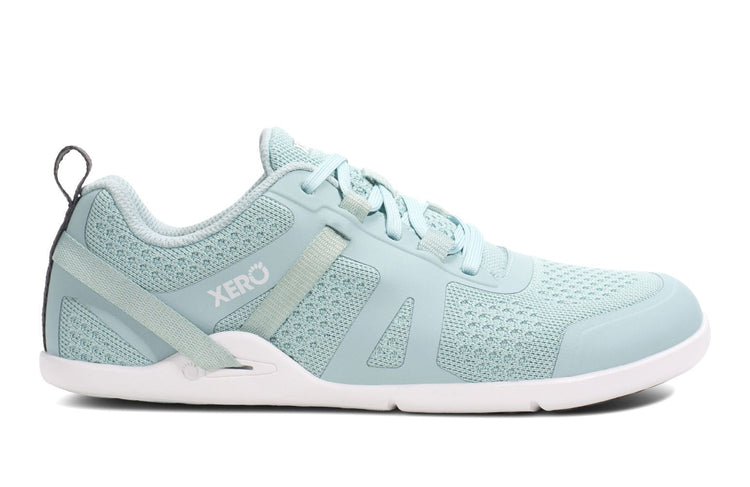
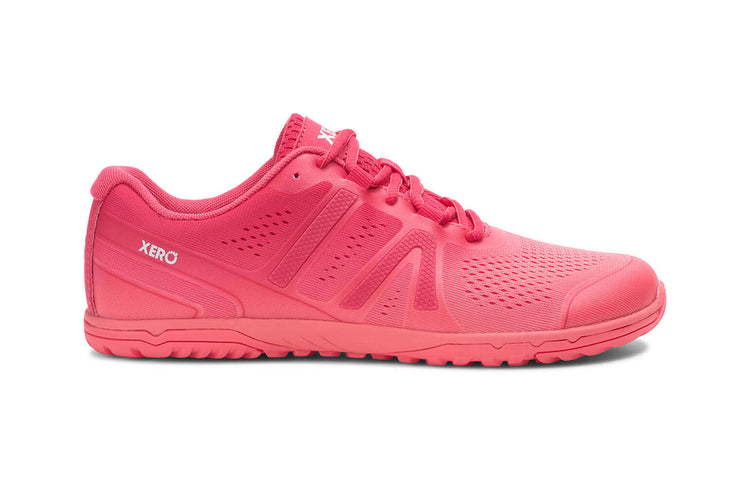
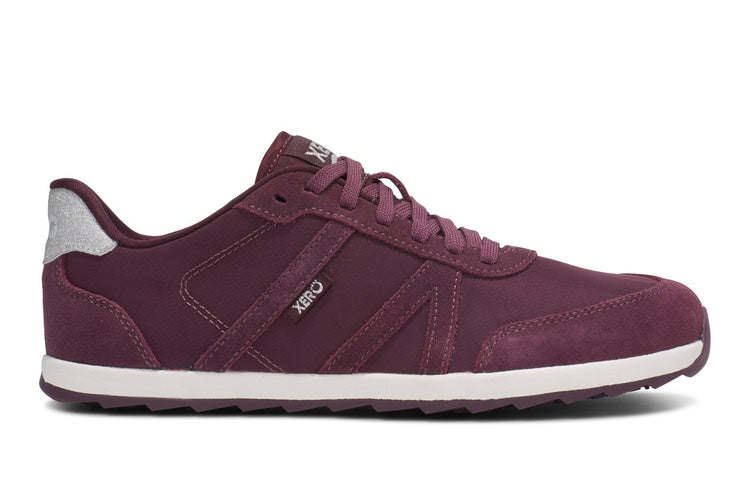
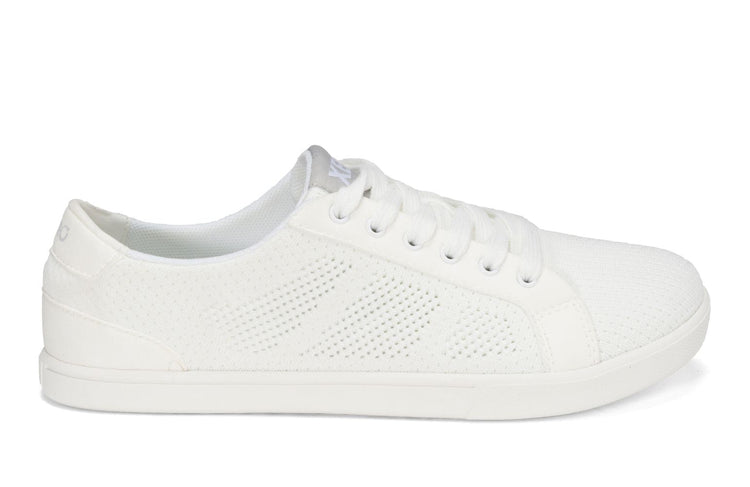
The thin sole of Xero Shoes is designed with a zero-drop sole which allows your feet to be low to the ground. We have several barefoot shoes for weightlifting including Prio, Prio Neo, 360, Forza Trainer.
The shoe’s wide toe box also lets your toes spread out, which adds stability, since it gives you a wider base. This is a lightweight shoe – when weightlifting, you’ll barely notice you have them on.
Don’t just take our word for it. Here’s what some weightlifters have to say about their experience with barefoot shoes:
Tips For Transitioning To Barefoot Exercise
Whether you are taking the plunge into going completely barefoot or switching to barefoot weightlifting shoes, here are some tips to get you started:
If you’ve never worn minimalist shoes before, you’ll want to introduce them the way you would any new exercise or gear—slowly.
Practice foot strength exercises. Those little muscles in your feet that are used to slacking off will need time to acclimate and strengthen. A 2019 study by Dr. Sarah Ridge found that walking in minimalist shoes strengthens the muscles in your feet as much as following a foot strengthening exercise program.
As your feet and muscles get stronger, slowly increase the duration and intensity of your workouts. Add new exercises and movements slowly to avoid overexertion.
Listen to your body and rest when needed. Don’t push yourself too hard too quickly or ignore any discomfort.
When you start heavy lifting with barefoot shoes, try using a removable insole so you can decide just how close to the ground you want to be.
Be patient on your barefoot training journey. Being patient can be difficult, but your body will thank you. In the long run, making the switch in your weightlifting routine will pay off.
The content of this post does not constitute and is not intended to be a substitute for professional medical advice, diagnosis or treatment. Always seek the advice of a physician or other qualified health provider with any questions or concerns you may have about your health or a medical condition.
Barefoot Shoes for Lifting
Xero Shoes has several models for barefoot weightlifting. Try the Prio, Prio Neo, 360, Forza Trainer model for weightlifting or strength training – available in many sizes and colors.